Engineering Finance & Business
Top Kubernetes Cost Observability Tools for FinOps

Published date: 04/05/2026

Kubernetes cost observability tools help teams move past cluster-level spend and understand who actually consumed shared infrastructure. In multi-tenant environments, tags often break down because pods share nodes, namespaces share clusters, and self-managed services sit outside normal cloud cost monitoring. This shortlist focuses on Kubernetes cost visibility, container resource cost allocation, and the FinOps tools that best fit different operating models.
Use these nine criteria to evaluate Kubernetes cost management platforms:
| # | Criteria | Why it Matters |
| 1 | Pod and workload-level allocation | Namespace views aren’t enough when several services or tenants share the same cluster. |
| 2 | Shared-resource attribution | Nodes, load balancers, storage, NAT, and data transfer costs should split by real usage. |
| 3 | Self-managed service visibility | Many teams need cost monitoring for Kafka, Elasticsearch, RabbitMQ, and similar shared systems. |
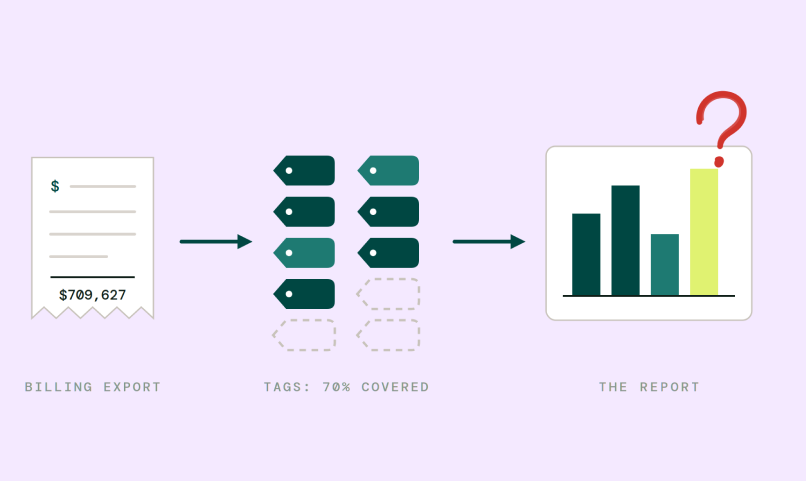
| 4 | Tagless vs. tag-dependent allocation | Tag hygiene is still the biggest blocker in cloud cost optimization. |
| 5 | Billing data latency | Billing data is delayed and describes provisioned resources, not actual consumption. |
| 6 | Customer-level cost-to-serve | SaaS teams need to calculate cost per customer, not just cost per cluster. |
| 7 | Multi-cloud and SaaS coverage | Kubernetes cost monitoring rarely lives in isolation from Snowflake, MongoDB Atlas, or AI spend. |
| 8 | Dashboard visibility | Enterprise teams need secure access by team, function, and stakeholder group. |
| 9 | Time-to-value | Good FinOps for Kubernetes should start producing answers in days, not after a long tagging cleanup. |
Best for: Multi-tenant Kubernetes, shared services, and customer-level cost attribution without tagging.
Attribute is the strongest option for teams that need Kubernetes cost observability tools built around runtime behavior instead of billing exports. It deploys an eBPF sensor that reads live system activity and maps costs to workloads, services, teams, features, and end customers. That makes it especially useful for organizations asking how to split EKS or Kubernetes costs by service, team, or tenant, or how to calculate cost per customer in Kubernetes-based SaaS environments.
It also covers areas most FinOps tools miss, including network traffic costs, self-managed Kafka, Elasticsearch, plus Snowflake, MongoDB, OpenAI, Anthropic, Bedrock, and Vertex. Most tools stop at the cluster. Attribute connects every layer, compute, network, shared services, and AI spend, into a single TCO view. For teams comparing no-tagging FinOps platforms for SaaS companies, Attribute stands out because it doesn’t depend on resource metadata to allocate shared cloud costs across microservices.
Tradeoff: Sensor deployment needs platform team coordination, and broader unified multi-cloud reporting is still developing.
Best for: In-cluster Kubernetes cost monitoring, right-sizing, and idle resource cleanup.
Kubecost and OpenCost are widely used Kubernetes cost management tools for teams that want a K8s-native view of spend. They work well for cloud cost optimization inside the cluster, especially for requests, limits, idle capacity, and rightsizing work. They’re also a practical starting point for teams exploring FinOps for Kubernetes cost optimization with open source tooling.
Tradeoff: Allocation beyond namespace or label quality is limited. They don’t provide strong customer-level attribution and usually can’t track cloud costs for shared resources like Kafka or Elasticsearch that live outside standard K8s objects.
Best for: Organizations with mature tagging that want polished cloud spending analytics.
CloudZero is a strong fit for companies with solid tag coverage and a broad cloud cost monitoring program. It offers reporting for cloud cost optimization and business mapping across services, accounts, and products. For teams with a disciplined tagging culture, it can be a useful finops solution.
Tradeoff: It remains tag-first. If you’re searching for the best FinOps tools for cloud cost attribution without tagging, this isn’t the right fit. Shared infrastructure and multi-tenant consumption remain difficult to allocate accurately.
Best for: Rule-based grouping across cloud and SaaS spend.
Finout is useful for teams that want more flexible grouping through virtual tagging and rule logic. It can improve cloud infrastructure ROI by helping finance and engineering teams organize spend without changing every underlying resource tag. It also supports broader cloud spending analytics across vendors.
Tradeoff: Virtual tags still depend on existing metadata. It doesn’t read runtime activity, so it won’t answer how untagged and shared cloud resources are consumed in real time.
Best for: Automated Kubernetes cost optimization.
CAST AI is strongest when the goal is to reduce Kubernetes spend through automated rightsizing, bin packing, and spot usage. It belongs on the shortlist for teams focused on savings execution rather than attribution depth.
Tradeoff: It’s not built to measure gross margin by customer for a SaaS product or deliver detailed tenant-level cost visibility. It reduces the bill, but doesn’t explain who caused the remaining cost.
Best for: Teams already standardized on Harness.
Harness Cloud Cost Management works best for engineering organizations that already run CI/CD and platform workflows in Harness. It adds cost visibility near the rest of the delivery toolchain and can support basic cloud cost monitoring.
Tradeoff: It is still largely billing-driven and tag-dependent, with limited depth for self-managed infrastructure and shared service allocation.
Best for: Lightweight multi-cloud dashboards and showback.
Vantage is a good option for smaller teams that want easy reporting across cloud accounts and vendors. It can support straightforward cloud spending analytics and basic cost visibility across environments.
Tradeoff: Its Kubernetes cost observability is relatively shallow. It isn’t designed for container resource cost allocation at the tenant or customer level.
Best for: Large enterprises with formal ITFM or chargeback processes.
Cloudability fits organizations that need broad financial governance and already work in Apptio-centric workflows. It can support enterprise reporting and structured cloud cost management programs.
Tradeoff: Time-to-value is often slower, and Kubernetes cost visibility may not meet the needs of platform teams trying to split shared infrastructure by actual workload consumption.
Best for: Teams already using Datadog for observability.
Datadog CCM is attractive when engineering teams want cloud cost monitoring in the same platform they already use for metrics, traces, and logs. It gives teams one place to review infrastructure and cost signals.
Tradeoff: Cost allocation still depends heavily on tags and billing data. It isn’t built for customer-level cost attribution or detailed shared service allocation without tagging.
Best for: Recommendation-driven resource management.
Turbonomic helps teams act on optimization recommendations across infrastructure resources and application performance. It can improve efficiency and support cost reduction decisions.
Tradeoff: Attribution isn’t the main lens. Teams looking for the best tools for cloud unit economics and cost-to-serve analysis will usually need something more allocation-focused.
Where tagless, behavior-based cost grouping fits
Multi-tenant Kubernetes is where traditional finops tools struggle most. Tags describe provisioning. Runtime behavior shows actual consumption.
Behavior-based attribution is especially useful in four cases:
For teams managing Kubernetes cloud spend in a shared, multi-tenant SaaS environment, the deciding factor isn’t dashboard polish. It’s whether the platform can allocate shared costs based on what actually happened inside the system.