Engineering Finance & Business
You’re Not Ready for the AI Bill That’s Coming

Published date: 06/05/2026

There’s a pattern showing up across engineering teams right now.
A team is building. Rolling out AI tools. Adding LLM features to the product. Full speed on adoption. And when the topic of cost visibility comes up, the answer is some version of: “That’s not a priority yet. We’ll deal with costs once we’re off the ground.”
It sounds reasonable. It isn’t.
AI costs don’t accumulate slowly and visibly. They spike. A new feature ships. Traffic picks up. One customer starts using the AI workflow 10x more than anyone else. The LLM calls multiply. The bill grows.
By the time it shows up in your cloud invoice, you’re already weeks behind. And by the time you’ve figured out which workload, which customer, or which team caused it, you’re staring at a problem that’s been compounding in the dark.
The assumption that “we’ll fix costs after launch” only works if you can see the costs when you’re ready to look. Most teams can’t.
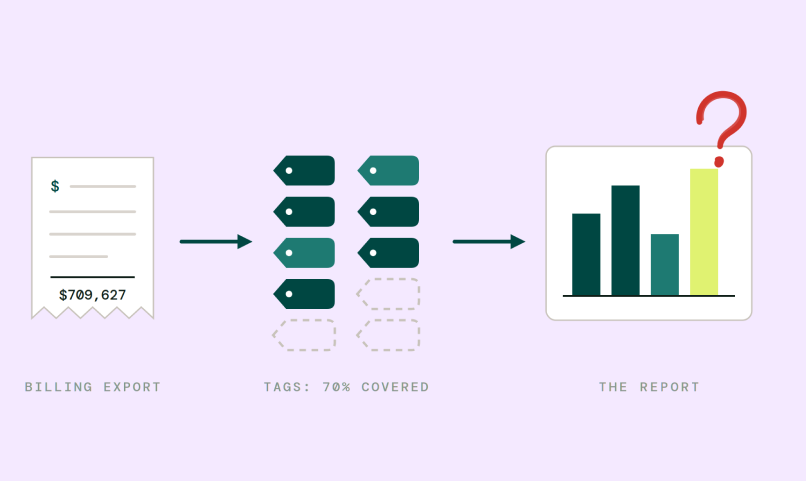
The standard FinOps playbook says: tag your resources, allocate by tag, report by team. That playbook was designed for infrastructure that moves slowly. AI workloads don’t move slowly.
LLM calls are ephemeral. A model inference request doesn’t map to a tagged resource. When you’re running ten microservices and any of them might be calling an LLM, the billing export won’t tell you which one. It definitely won’t tell you which customer triggered it.
By the time your team has designed a tagging schema, rolled it out, and cleaned up the gaps, you’ve already shipped three more features. The coverage is always partial. The gaps are always in the most expensive places.
Here’s what actually happens when teams wait:
They launch. Usage grows faster than expected (ideally). The AI spend is invisible inside a blended cloud bill. Nobody knows which customers are profitable and which are costing more to serve than they pay. Pricing decisions get made on assumptions. A quarter later, the CFO asks where the margin went.
One Attribute customer discovered that 360 of their accounts had monthly COGS exceeding their revenue. More than $1.3M in losses. They had no visibility into this before. No existing tool had surfaced because no existing tool could connect cloud spend to specific customer accounts without tagging.
They couldn’t tag their way to that answer. The infrastructure was too complex. The workloads were shared. The relationships between customers and compute weren’t captured in resource metadata. They needed a different approach.
The teams that handle AI cost growth well aren’t the ones with better tagging discipline. They’re the ones with runtime visibility.
They know which customers are driving which AI workloads. They know which microservices are making LLM calls and how much each call costs. They know this in time to adjust pricing, throttle usage, or have a commercial conversation with the customer. Not after the quarter closes.
This is not a FinOps-team problem. It’s an engineering and product problem. The teams building AI features are the ones who need to see the cost signal early, before it becomes a finance cleanup exercise.
Before your AI workloads scale, you have a window. A short one.
Right now, the complexity is manageable. The workloads are new. The customer usage patterns are forming. If you instrument for cost attribution now, you’ll have clean data from the start. You won’t be trying to reconstruct history from a billing export after the spike.
The teams that wait until costs are a problem are the teams that spend the next quarter building spreadsheets instead of features. They’re trying to reverse-engineer what they could have just observed.
Attribute reads your live system via eBPF. No tagging. No instrumentation changes. No waiting for the billing export.
From day one, you see which workloads are driving which costs. Which customers are consuming your AI infrastructure and at what expense. Which LLM calls are flowing through your system and what they cost by workload, product feature, and end customer.
When your AI spend grows, you see it in real time. You know which customer triggered the spike. You know whether your pricing covers the cost of serving them.
You stop managing cost by looking backward. You start managing it while it’s happening.
AI costs aren’t going to get simpler. The teams that get ahead of them now are the ones that will still have good margins when the growth gets real.
If you’re in build mode and cost visibility is on the roadmap, it’s worth asking: what does the bill look like when you’re ready to look at it?